
How Do General Contractors Maintain Job Site Safety in Mesa, AZ?
Safety on a lived-in remodel comes down to four habits. Crews contain the work area, control dust at the source, secure the site each evening, and schedule around the heat.
None of that shows up on a proposal, but all of it is visible by day three, when a system either holds up or it doesn’t.
West Coast Painting & Construction has run Mesa house painting and remodeling crews since 1978, and those four habits carry across both kinds of work. If you’re looking for a dependable house painting crew in Mesa, AZ, this is pretty much what that looks like day to day. It’s not flashy, just consistent, and honestly that’s the whole point.
Containing the Work Area Before Anything Is Opened
Containment happens before demolition, not after the first mess. Floors get covered along the whole path the crew walks, not just inside the room, since the hallway between the work area and the front door often sees more traffic than the job site itself.
Temporary barriers close the opening with plastic sheeting on a pole system or a framed wall. A zippered door keeps that barrier intact through hundreds of trips.
The HVAC system is the part homeowners rarely think about, and contractors regret skipping. Supply and return registers inside the containment area get sealed before anything is opened up, and ductwork running through the zone gets isolated at its joints too, so dust can’t sneak in through unsealed seams.
Skip that step, and a return vent pulls demolition dust straight into the air handler, spreading it through the house, and that’s how you end up with a clean kitchen and dirty coils. The same attention to protecting a space carries into interior painting services, where masking and floor coverage matter just as much as they do during a tear-out.
Controlling Dust Where It Is Created
Containment holds dust inside a zone, while source control keeps it from becoming airborne in the first place, which is honestly the cheaper half of the job. Crews wet surfaces before removing or disturbing them, and that alone stops a large share of the dust.
Vacuum-attached tools and HEPA air scrubbers handle the rest. Negative pressure helps too, where the layout allows it, since air then flows into the work area through gaps rather than out of it.
Homes built before 1978 carry an added requirement, since the EPA’s Renovation, Repair, and Painting Rule sets specific work practices for those properties. It covers work area containment, cleanup procedures, and a cleaning verification process at the end.
Mesa has a fair number of homes from that era, especially around the central and downtown neighborhoods. That kind of rule is just one more reason a daily construction workflow at the job site needs to be consistent, not something crews figure out as they go.
Heat Is the Variable Most Crews Underestimate Here
Arizona heat is a safety issue for the crew and a quality issue for the work, and the two are connected more tightly than most homeowners expect. Surface temperatures on a west-facing stucco wall run far above the air temperature in summer.
That’s hard on the people working against it and just as hard on anything applied to it. We start early during the hot months and follow the shade around the property as the day goes on.
Coatings behave differently in that kind of heat too. Applying to a surface above 90 degrees, or one sitting in direct sun, changes how the film actually cures.
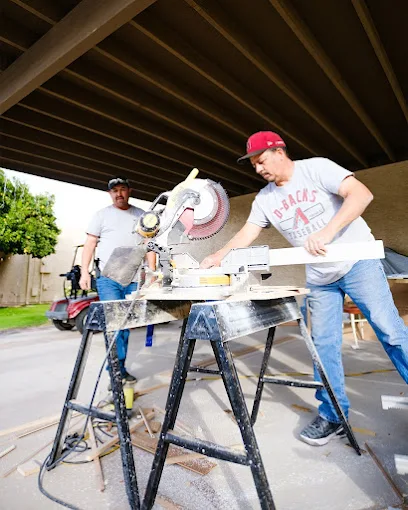
Scheduling around the sun is part of the specification, not just a courtesy to the crew. Water, shade breaks, and rotation belong in the day plan, not a policy binder, because that’s how extreme heat affects construction work on both the crew and the materials.
Noticed paint peeling or blistering on a sun-facing wall this summer? Give us a call at (480) 827-2151, and we’ll take a look before it turns into a bigger repair.
Securing the Site at the End of Every Shift
- Tools and blades collected and locked, never left on a counter or a stair tread overnight
- Openings closed, with any hole in an exterior wall or roof sealed against weather and entry
- Power tools unplugged and cords coiled off walking paths
- Debris removed daily rather than accumulating into a pile that becomes a hazard itself
- Containment checked so barriers and floor protection are intact before the next morning
Daily cleanup does more than just keep a house livable. Surveys of remodeling customers put job site cleanliness at the top of the list for satisfied clients. It also prevents the small injuries that happen after hours, when a child or a pet finds something left out.
A site that is put away every evening tends to be a site run properly during the day. The same nightly reset applies on occupied business properties, where commercial painters in Mesa need every room masked, cleaned, and ready for staff and customers by the next morning. The reverse holds just as reliably, which makes the end of day three a useful checkpoint. Walk the work area yourself that evening. What you find tells you more about the crew than any reference call will.
What Licensing, Insurance, and Your Own Questions Cover
Ask to see a current license and a certificate of insurance before work begins. Read what the certificate actually names, rather than taking the word insured at face value.
General liability covers damage to your property, while workers’ compensation covers injuries to the people working on it. Its absence is the exposure most homeowners never think about until somebody actually gets hurt in their house.
Crew structure matters alongside the paperwork. Employees work under one company’s training and supervision.
A chain of subcontractors means the people in your house might answer to somebody you’ve never met. Our crews handle painting, stucco, drywall, and finish work directly, which is why protection and cleanup stay consistent from one trade to the next.
That sequence is worth understanding before work even starts, since most of these steps happen before you see any real progress. A walkthrough of a typical day on site shows where each one falls. Knowing the order just makes it easier to tell a slow morning from an actually skipped step.
Have questions about a painting or remodeling project, or just want a straight answer on cost and timeline first? Contact us, and we’ll help you figure out the right next step for your home.
Related Topics: